
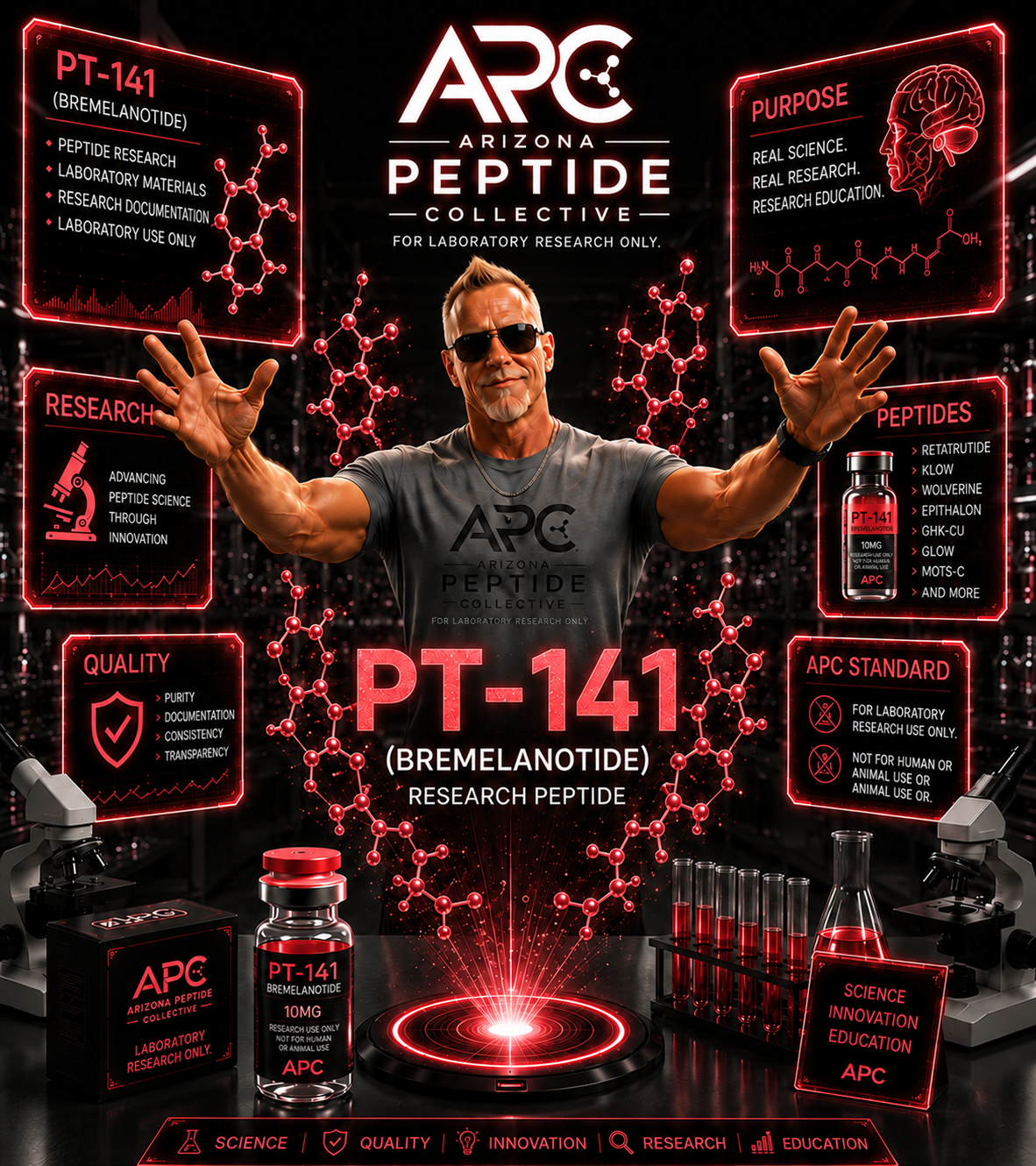
PT-141
Melanocortin Receptor Research
For Research Use Only - Not Medical Advice

What is PT-141?
PT-141 (Bremelanotide) is a synthetic peptide derived from the melanocortin peptide family. Unlike compounds that act primarily through vascular pathways, PT-141 is studied for its activity at melanocortin receptors within the central nervous system, particularly MC3R and MC4R.
Researchers have investigated PT-141 for its effects on neural signaling pathways associated with sexual motivation, arousal, and behavioral response. Its distinct mechanism has made it an important compound in melanocortin receptor and neuroendocrine research.
Research Use Only. Not Medical Advice.
Why Researchers Are Interested
Researchers are interested in PT-141 because it interacts with the melanocortin receptor system, particularly receptors involved in central nervous system signaling.
Unlike compounds studied primarily for vascular effects, PT-141 provides researchers with a way to investigate neural and neuroendocrine pathways associated with sexual motivation, arousal, and behavioral response.
Its unique mechanism has made PT-141 a useful research compound for studying the relationship between melanocortin signaling, the brain, and sexual behavior.
Research Use Only. Not Medical Advice.
Current Areas of Research
Current PT-141 research includes several areas related to melanocortin receptor signaling and neuroendocrine function, including:
Melanocortin receptor activity — particularly signaling involving MC3R and MC4R.
Sexual motivation and arousal — investigating how central nervous system pathways influence sexual response.
Neuroendocrine signaling — studying interactions between neural pathways, hormones, and behavioral responses.
Central nervous system mechanisms — exploring how melanocortin signaling affects neurological and behavioral processes.
Sexual dysfunction research — evaluating melanocortin pathways as potential targets in disorders involving sexual desire and arousal.
PT-141 remains particularly interesting because its research focus is primarily on central signaling rather than direct vascular mechanisms.
Research Use Only. Not Medical Advice.
Frequently Asked Questions
Have questions about PT-141? Here are the answers to the most common questions based on current science.
What is PT-141?
PT-141, also known as bremelanotide, is a synthetic melanocortin peptide studied for its effects on melanocortin receptor signaling, particularly within the central nervous system.
How does PT-141 differ from compounds that act through vascular pathways?
PT-141 is notable because its primary mechanism involves central melanocortin receptor signaling rather than directly targeting blood flow or vascular function.
Which receptors are associated with PT-141 research?
Research has focused particularly on the MC3 and MC4 melanocortin receptors, which participate in several neurological and behavioral signaling pathways.
Why is PT-141 studied in sexual-function research?
Melanocortin pathways are involved in neural processes associated with sexual motivation and arousal. This has made PT-141 an important research compound for investigating the neurological components of sexual response.
Is PT-141 the same as bremelanotide?
PT-141 is the developmental/research name commonly associated with bremelanotide.
Is PT-141 intended for human use?
APC products labeled PT-141 are offered strictly for laboratory research purposes and are not intended for human or animal consumption.
Research Use Only. Not Medical Advice.
.
Research Disclaimer
Arizona Peptide Collective is committed to providing accurate, science based educational information.
The information provided by Arizona Peptide Collective is intended solely for educational and informational purposes. The content presented throughout this Research Library summarizes publicly available scientific literature and ongoing areas of peptide research.
Arizona Peptide Collective does not provide medical advice, diagnose medical conditions, prescribe treatments, or recommend the use of any investigational compounds. The information on this website should not be interpreted as medical, pharmaceutical, or healthcare guidance.
Many peptides discussed within this Research Library remain investigational and may not be approved by the U.S. Food and Drug Administration (FDA) for general clinical use. Research in this field continues to evolve, and scientific understanding may change as new studies become available.
Visitors should consult a qualified healthcare professional regarding any medical questions or treatment decisions.
Research only. Not medical advice.
Explore More Research
GHK-Cu
Research involving skin, collagen, and tissue repair.
Epithalon
Research focused on aging and cellular biology.
SS-31
Research focused on mitochondrial function, cellular energy, and oxidative stress.
Retatrutide
Research exploring metabolism and energy regulation.
Wolverine
Research investigating tissue healing and regeneration.
MOTS-c
Research focused on mitochondrial signaling, metabolism, and cellular energy regulation.